
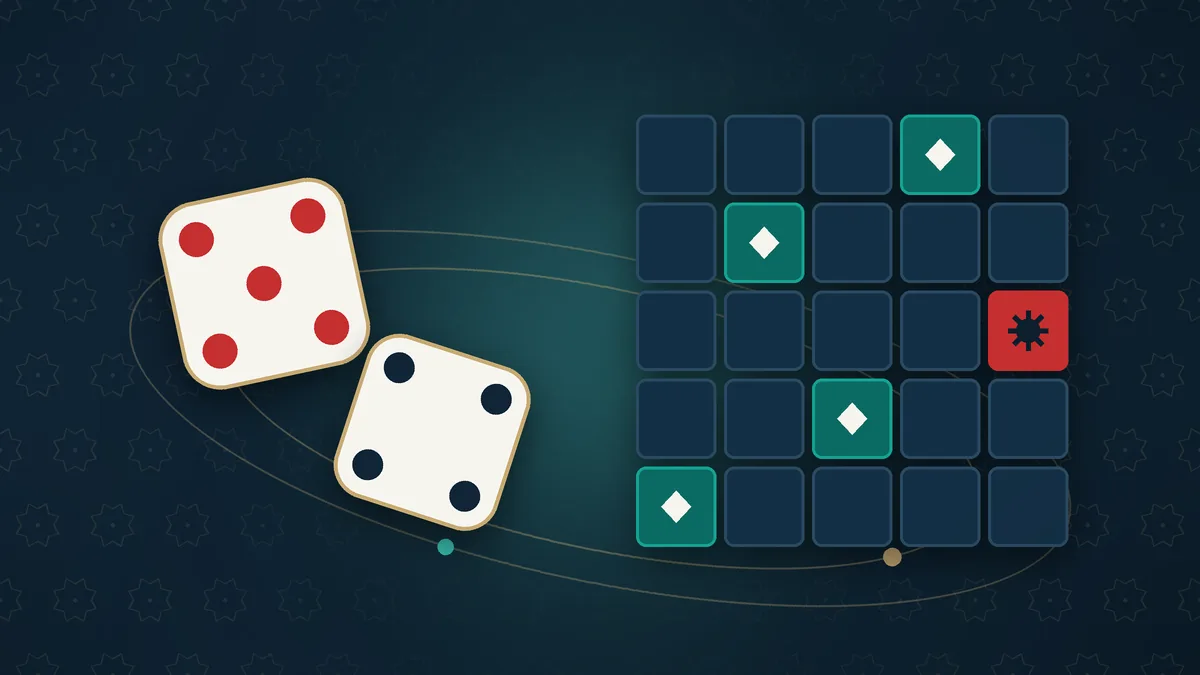
Both games in 30 seconds
Dice: a random number from roughly 0 to 100. You pick a threshold and bet that the result lands over or under it. The bigger your chance, the smaller the multiplier. Spribe describes its Dice as letting you set the win chance across a wide range, with a top multiplier of 970x.
Mines: a 5 by 5 grid of 25 tiles hides a number of mines that you choose. Each safe tile you reveal raises the multiplier, and you can cash out after any step. Reveal a mine and you lose the stake. Spribe says its Mines lets you cash out after every successful move.
How to play dice, step by step
- Set your stake.
- Move the slider to choose the threshold, and pick “over” or “under”. The game shows the win chance and multiplier at once.
- Press roll. A random number appears.
- If it lands on your side, you get the stake times the multiplier; otherwise you lose it.

How to play mines, step by step
- Set the stake and the number of mines (1 to 24 in many versions; 1 to 10 in our practice game).
- Reveal a tile. If it is safe, the multiplier rises.
- Decide: cash out at the current multiplier, or reveal another tile.
- If you hit a mine the round ends and the stake is lost. The mines have been fixed since the round began.

The dice maths
With a 49.5% chance and a 97% RTP, the multiplier is 97 ÷ 49.5, about 1.96x. The expected return of each roll is the probability times the multiplier, which is always 0.97 of the stake. The table compares Spribe’s published 97% with our practice game’s 99%.
| Chance to win | Multiplier at 97% RTP | Multiplier at 99% RTP |
|---|---|---|
| 90% | 1.078x | 1.10x |
| 49.5% | 1.96x | 2.00x |
| 25% | 3.88x | 3.96x |
| 10% | 9.70x | 9.90x |
| 1% | 97x | 99x |
The top multiplier Spribe lists (970x) fits the same formula at a 0.1% chance. The big number is not special generosity; it is a small probability at its usual price.
The mines maths
With 3 mines in 25 tiles, the chance that the first tile is safe is 22 in 25, or 88%. Then 24 tiles remain with 3 mines, so the second tile’s chance is 21 in 24, and so on. The multiplier after any number of tiles is the RTP divided by the chance of getting there. The table uses 97%:
| Mines | After 1 tile | After 3 tiles | After 5 tiles | After 10 tiles |
|---|---|---|---|---|
| 1 | 1.01x (96%) | 1.10x (88%) | 1.21x (80%) | 1.62x (60%) |
| 3 | 1.10x (88%) | 1.45x (67%) | 1.96x (49.6%) | 4.90x (19.8%) |
| 5 | 1.21x (80%) | 1.96x (49.6%) | 3.32x (29.2%) | 17.16x (5.7%) |
| 10 | 1.62x (60%) | 4.90x (19.8%) | 17.16x (5.7%) | About 1,056x (about 0.09%) |
The brackets show the chance of getting there. Notice that 3 mines after 5 tiles pays almost exactly what 5 mines after 3 tiles pays: the probability is the same, so the price is the same.
The one decision you make mid-round, continue or cash out, does not change the cost either. Cashing out after two tiles or after ten returns 97% of the stake on average in both cases. What changes is how often you leave with a small win and how often you lose everything.
That also explains the maximum win Spribe lists for its game, 5,044,291x. It is the 0.97 RTP times the number of ways to choose 12 tiles out of 25 (5,200,300): what the game pays someone who clears all twelve safe tiles on a grid with 13 mines. The chance of that is about one in five million.
The kinds and how they differ
| Game | Source | RTP | Note |
|---|---|---|---|
| Dice | Spribe | 97% | Single-player, top multiplier 970x, customisable autoplay |
| Mines | Spribe | 97% | Single-player, maximum win 5,044,291x |
| Plinko | Spribe | 97% | Same family: a disc drops through pegs, maximum win 555x |
| Operator dice and mines | The operator | Stated in the game rules | Often provably fair, among the originals |
| Our practice games | This site | 99% | Play money, no prizes |
How to check a roll was fair
Most originals-style dice and mines games run a provably fair system. It has three parts: a server seed chosen by the operator, whose encrypted fingerprint (hash) you are shown before you bet; a client seed you can change yourself; and a counter that rises with every bet. The three are combined to generate the result. Once you rotate the server seed, the operator reveals the old one, and you can check that its hash matches what you were shown and that your results really come from it.
What does this prove? That the operator did not change the result after seeing your bet, and that the mines were fixed from the start. What does it not prove? That the game is cheap. The edge is built into the multiplier table and stays there whatever the seeds. In my view this is the most misunderstood point about originals: “verifiable” does not mean “in your favour”.
An honest strategy
- Compare the RTP first: a 99% game costs a third of what a 97% game costs per dirham. Read the figure in the game rules at the operator.
- Pick the probability for the swing you want: a 90% dice chance or one mine means frequent small wins and a rare loss that wipes out dozens of them.
- Be wary of autoplay: it allows hundreds of rolls in minutes, which turns a small percentage into a large amount. If you use it, cap the number of rolls and set a loss limit.
- Do not change the stake after a loss: an “increase 100% on loss” setting is a Martingale with a machine wrapper.
The Martingale on dice, in numbers
At a 49.5% chance and a multiplier near 2x, ten losses in a row happen about 0.11% of the time. That looks tiny, but anyone auto-rolling thousands of times meets that run regularly. Starting at AED 1, you have lost AED 1,023 to win back one dirham, and the eleventh bet is AED 1,024. And at 97% RTP the multiplier is 1.96x, so a win does not even fully cover the earlier losses.
An AED session budget
Hypothetical example 1,000 rolls at AED 1 is AED 1,000 staked even if you started with only AED 100, because wins are staked again. At 97% RTP the average theoretical loss is AED 30; at 99% it is AED 10. A reasonable plan: a AED 150 budget, a AED 1.50 stake (1%), a AED 75 loss limit and a 300-roll cap. The details are in our bankroll management guide.
Common mistakes
- Believing a high number is “due” after a run of low ones.
- Running autoplay without a loss limit.
- Revealing “one last tile” after you had decided to cash out.
- Confusing provably fair with the house edge: the first proves fairness, the second stays where it is.
- Forgetting that these games may be excluded from wagering.
Practise before you play
Try our practice dice (a roll from 1 to 100 and a chance between 4% and 95%) and practice mines (1 to 10 mines), both with a 1% edge and a 1,000-point balance. Keep the stake fixed, change the probability, and watch how the losing runs change length.
Where to find dice and mines
Our research sheet lists originals at Stake, Duelbits, Shuffle and TrustDice, all international operators that are Not UAE-licensed. The list does not mean a particular dice or mines game is offered, nor what its RTP is: read the rules at the operator. See also crash games, Spribe, our crash guide which uses the same maths, and the legal status page.
Adults 21+ only. Speed is what makes these games expensive. Fix the number of rounds before you start, and read responsible gambling if you go past your limits.
Sources: Spribe game data (Dice, Mines and Plinko, 8 November 2026), the code of our practice games, and combinatorial probabilities for a 5 by 5 grid.





 Responsible gambling


