
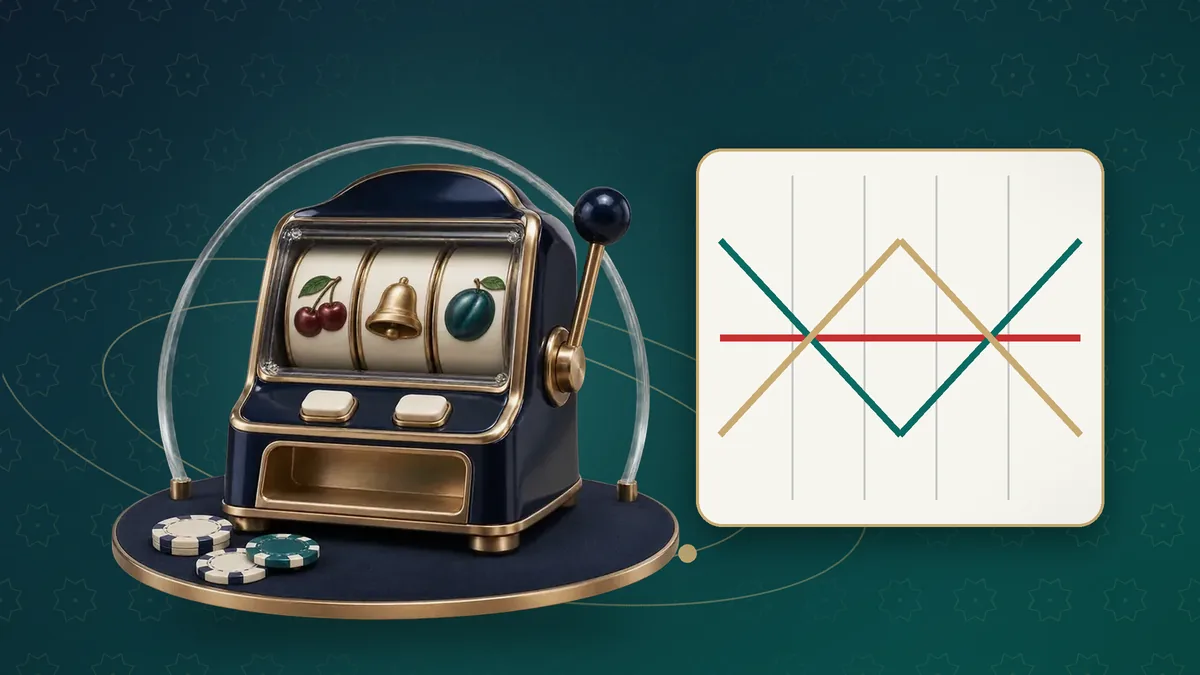
Slots in 30 seconds
A grid of reels (usually 5 reels by 3 rows, or 6 by 5) shows symbols. You choose a stake and press spin; the reels stop on a combination, and the game pays if it matches the paytable. On top of that come the features: wilds that substitute, scatters that open free spins, multipliers and bonus rounds.
Wikipedia sums up the history: mechanical reels gave way to random number generators, and buttons and touchscreens replaced the lever. An online slot has no reels at all, only software that picks the result and then shows it.
What happens when you press spin
- You set the stake per spin. In line games you may see a value per line and a number of lines; the total is what is deducted.
- You press spin, and the stake leaves your balance at once.
- The random number generator picks where each reel stops. The result is settled at this moment.
- The game shows the reels spinning and stopping. The spin and the suspense are a visual show that changes nothing.
- The game checks the combination against the paytable, adds any win to the balance, or starts a feature if its symbols landed.

That is why stopping the reels by hand, changing the timing of your press or waiting for a machine’s “cycle” means nothing. Each spin is independent of the last.
Paylines, ways and pay anywhere
These are different ways of deciding what counts as a win. Wikipedia notes that traditional three-reel machines had one, three or five paylines and that video slots may have as many as 1,024. The table uses examples from the game pages on this site.
| System | How a win is counted | Example |
|---|---|---|
| Fixed paylines | Matching symbols on a set line from the left | Book of Dead: 10 lines; Wolf Gold: 25 lines |
| Both ways | A line counts from the left or from the right | Starburst: 10 lines that pay both ways |
| Megaways | A changing number of symbols on each reel every spin | Bonanza Megaways: up to 117,649 ways |
| Pay anywhere | 8 or more matching symbols in any position | Gates of Olympus and Sweet Bonanza: a 6 by 5 grid |
| Clusters | 5 or more touching symbols | Sugar Rush and Reactoonz: a 7 by 7 grid |
More ways does not mean a more generous game. The provider sets the pay values to match the number of ways, so the RTP remains the figure that decides the cost.
RTP: what 96.50% means
Return to player is the share of all stakes a game pays back over an enormous number of spins. Pragmatic Play’s page for Gates of Olympus lists 96.50%, so the house edge is 3.50%: of every AED 100 that passes through the game, AED 3.50 stays with the casino on average.
The catch is that one game can come in several versions. Bigwinboard lists Gates of Olympus versions at 95.50% and 94.50%, and Hacksaw publishes four versions of Wanted Dead or a Wild: 96.38%, 94.55%, 92.33% and 88.42%. The operator picks the version, and the right figure is the one in that operator’s game information screen, not the one in a general review.
In progressive jackpot games part of every stake feeds the top prize, so the base return looks low. Mega Moolah, for example, is at 93.42%.
Volatility and hit frequency
Volatility describes how the return is distributed: two games at 96% can feel completely different. A low-volatility game pays small amounts often; a high-volatility one goes through long stretches with little coming back, then pays a rare large amount, usually in free spins.
| Volatility | Examples from our pages | What to expect |
|---|---|---|
| Low | Starburst (96.09%) | Frequent small wins, a balance that wears down slowly |
| Medium | Gonzo’s Quest (95.97%), Wolf Gold (96.01%) | A balance of small and large |
| High | Sweet Bonanza (96.48%), Big Bass Bonanza (96.71%), Book of Dead (96.21%) | Long stretches without a win; the value sits in the features |
OLBG puts the hit frequency of Big Bass Bonanza at about 13.66% of spins, so roughly 86 spins in 100 pay nothing in the base game. That is not a flaw; it is what high volatility looks like.
Where the value hides: features
In high-volatility slots a large share of the return comes from features rather than the base game. In Gates of Olympus, for instance, four or more scatters award 15 free spins according to Pragmatic Play, and every multiplier landing on a winning spin during them is added to a total multiplier that lasts to the end of the round. In practice a session that never reaches the feature usually returns far less than the published RTP, and one that does can recover a lot at once. The average blends both cases; your session lives only one of them.
The maths in AED
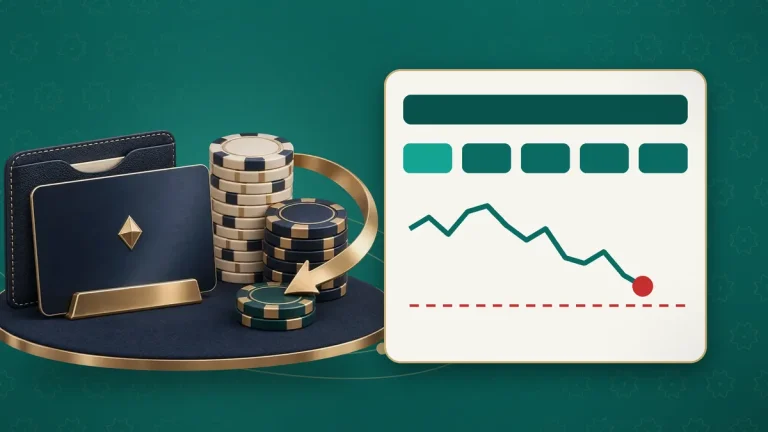
Hypothetical example 300 spins at AED 2 is AED 600 staked. At 96.50% RTP the average theoretical loss is AED 21. On a 94.50% version it becomes AED 33. On the 88.42% version of Wanted Dead or a Wild it is about AED 69.48, more than three times the top version of the same game.
Note that the amount passing through the game (AED 600) is usually much larger than the balance you started with, because small wins get staked again. That is why the cost of slots is measured by the number and size of spins, not by the opening balance.
A realistic slots strategy
You cannot influence a spin. The useful decisions all come before you start:
- Open the info screen: look for the RTP before the first spin. If the version is lower than the provider’s headline figure, you pay the difference.
- Match volatility to the budget: if your budget covers only 100 spins, a high-volatility game will often end before you see its feature. Lower the stake or pick a calmer game.
- Price the paid features: the Ante Bet in Sweet Bonanza adds 25% to each spin, and a feature buy costs 100x the bet where it is offered, AED 100 at AED 1 a spin.
- Mind the speed: turbo spin and autoplay raise the spins per hour, and so the cost. If you use autoplay, give it a loss limit.
As for the myths: the “hot” machine, changing the stake to confuse the game, waiting after a big win. None of them changes what the random number generator does.
A session budget
Hypothetical example A AED 200 session budget. In a high-volatility game we want at least 200 spins, so the right stake is AED 1. The loss limit is the AED 200 (no top-up), and a win limit is optional: if the balance doubles, withdraw half. The average theoretical loss over 200 spins at 96.50% is about AED 7, but losing the whole budget in a game like this is a normal outcome. A full plan is in our bankroll management guide.
Common mistakes
- Trusting an RTP from a general review without checking the version at the operator.
- A big stake on a high-volatility game with a short budget.
- Counting a “win” that returns less than the stake as a profit. It is a partial loss.
- Buying the feature to win back a loss.
- Forgetting that bonus terms may set a maximum bet and forbid feature buys.
Practise before you play
Our practice slot has three reels and a visible paytable, with a return computed from its code at about 97.2% (an edge of about 2.8%). It does not copy any commercial game, but it is enough to see a balance wear down slowly and then jump. For more on the numbers, read our RTP and volatility guide.
Where to find these slots
Our research sheet lists Pragmatic Play among the studios at Duelbits, Stake and Roobet, international operators that are Not UAE-licensed. A studio on the list does not mean a particular game or RTP version is offered. Browse our slots page, Pragmatic Play, Play’n GO and Hacksaw Gaming, and read the legal status page.
Adults 21+ only. Slots are the fastest-paced casino games, so set your limits before you start, and read responsible gambling if you notice yourself chasing losses.
Sources: Pragmatic Play’s Gates of Olympus page, Wikipedia’s Slot machine article (8 November 2026), and the figures on this site’s game pages (Hacksaw, Bigwinboard, OLBG).




 Responsible gambling


