
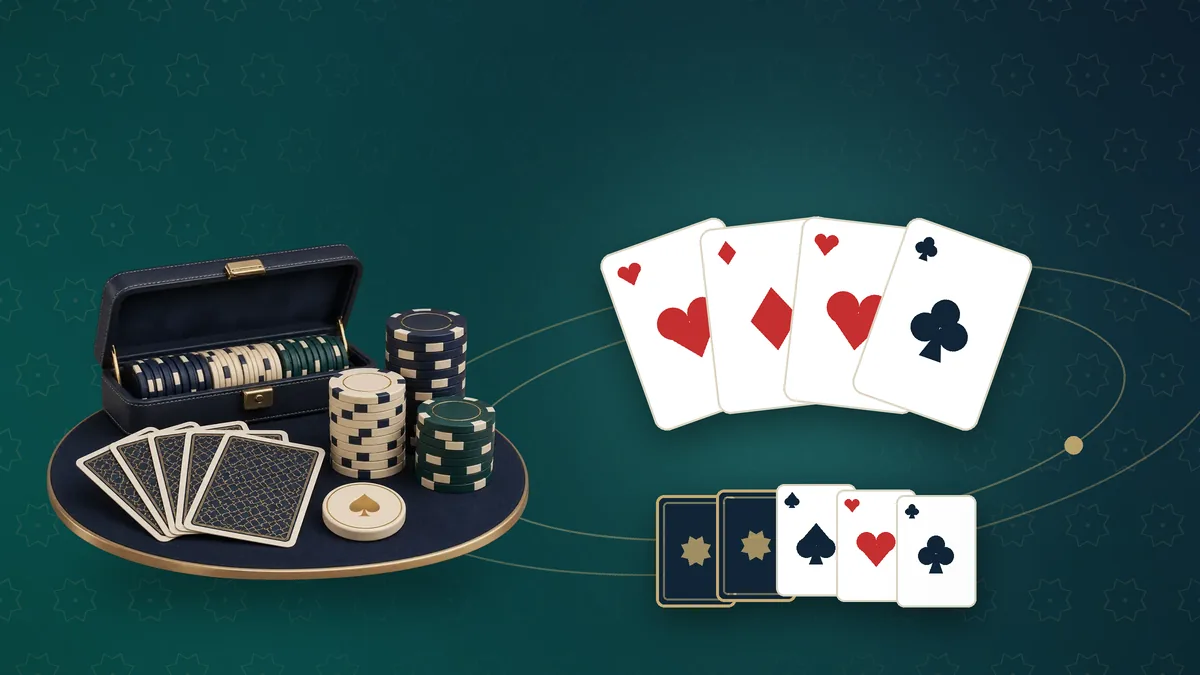
The three families in 30 seconds
In Omaha you get four hidden cards instead of two, and the board works as in hold’em: flop, turn and river. In Seven-Card Stud there is no shared board: seven cards per player, three hidden and four face up. In Five-Card Draw you get five hidden cards and one chance to swap. Wikipedia notes that hold’em replaced Seven-Card Stud as the most common game in US casinos in the 2000s, and that in Europe Omaha is usually played pot-limit.

How each family is played, step by step
Omaha
- Two blinds as in hold’em, then four hidden cards each and a betting round.
- The flop (three shared cards), the turn and the river, with a betting round after each.
- At showdown you make your hand from exactly two of your cards and exactly three from the board.
- In the Hi-Lo (eight or better) version the pot is split between the best high hand and the best qualifying low, five unpaired cards all 8 or lower.
Seven-Card Stud
- Each player posts a small ante, then gets two hidden cards and one face up (third street).
- The lowest face-up card pays a forced bet called the bring-in, and betting begins.
- Fourth, fifth and sixth street: one face-up card each, with a betting round after each, opened by the strongest visible hand.
- Seventh street: a last hidden card, a final betting round, then each player makes the best five-card hand from seven.
Five-Card Draw
- Five hidden cards each, then a betting round.
- The draw: discard any number of cards and receive replacements.
- A second betting round, then the showdown. Two betting rounds in the whole hand, against four in hold’em.
Side by side
| Game | Own cards | Shared cards | Betting rounds | Usual structure | Closest casino version |
|---|---|---|---|---|---|
| Texas Hold’em | 2 hidden | 5 | 4 | No-limit | Ultimate Texas Hold’em |
| Omaha | 4 hidden | 5 | 4 | Pot-limit (PLO) | No major dealer version |
| Seven-Card Stud | 3 hidden, 4 face up | 0 | 5 | Fixed-limit | Caribbean Stud, five cards |
| Five-Card Draw | 5 hidden | 0 | 2 | Home games, fixed-limit | Video poker |
Odds and cost
In a poker room
Room games have no house edge, because you play other players. The cost is the rake taken from the pot, or the fee on top of a tournament buy-in. Your result depends on your decisions compared with your opponents’, and then on variance.
Some useful numbers for each family, worked out from the deck itself. Omaha has 270,725 possible four-card starting hands, and each holds six two-card combinations, so hands run closer together before the flop than in hold’em. In stud, the chance of starting with three of a kind on third street is 52 in 22,100, once every 425 hands. In draw, keeping a pair and drawing three improves you to two pair or better about 28.7% of the time, and keeping four to a flush and drawing one completes it 9 times in 47, or 19.1%.
In the casino versions
| Version | Family | Cost | Source |
|---|---|---|---|
| Caribbean Stud | Five-card stud | 5.22% of the Ante, 2.56% of the total bet | Wizard of Odds |
| Oasis Poker | Stud with paid card swaps | 99.39% RTP | Betsoft |
| Russian Poker | Stud with swap decisions | Varies with decisions and pay table | Pragmatic Play |
| Jacks or Better 9/6 | Draw | 99.54% return with best play | Wizard of Odds |
| Let It Ride | No dealer hand | 3.51% of one bet | Wizard of Odds |
Strategy for each family
Omaha: play for the best hand, not a good one
Because strong hands are more common, the flush that wins in hold’em often loses in Omaha to a higher flush. Prefer draws to the best possible hand, and remember the two-card rule: four hearts on the board give you nothing if the ace of hearts is your only heart.
Worked example In pot-limit Omaha the pot holds AED 100 and your opponent bets AED 50. Your maximum raise is the call (AED 50) plus the size of the pot after it (100 + 50 + 50 = 200), so your total bet becomes AED 250. Bets grow quickly, so do the sum before the hand starts.
Stud: remember what you saw
Face-up cards are free information. If you are drawing to a spade flush and four spades have shown in other players’ hands, your outs have roughly halved. Start with strong hands (high pairs, three high suited or connected cards) and fold the rest early. Always compare your hand with what your opponents show, not with what it looked like two cards ago: a good card for you means little if their exposed cards promise something stronger, and staying in because you have already put a lot in is an expensive habit in a game with five betting rounds.
Draw: count before you swap
Do not draw to an inside straight: 4 cards in 47 give you only 8.5%. An open-ended straight is 8 in 47 (17%) and a flush 19.1%. Every card you swap also tells your opponents something: a one-card draw usually means a straight or flush draw, or two pair.
In the casino: a decision chart
In Caribbean Stud Wizard of Odds’ general rule is to always raise with a pair or better and fold anything below ace-king; the ace-king hands are the tricky ones. No betting system changes the edge.
Budget: a worked example in AED
Hypothetical example In Caribbean Stud at AED 20 on the Ante you raise in about 52.23% of hands with best play, so your average bet is 2.045 times the Ante, about AED 41. The expected loss is 5.22% of the Ante, about AED 1.04 a hand, or AED 52 over fifty hands. In an Omaha tournament with an AED 50 buy-in, the most you can lose is AED 50 unless you buy in again, which makes small tournaments a disciplined way to learn a new game. Pot-limit Omaha swings more than hold’em, so give it a wider budget or smaller stakes. More in the bankroll management guide.
Which game to learn first
In my view, learn hold’em first and then move to Omaha, not the other way round. Hold’em teaches board reading, position and pot odds with fewer cards; Omaha adds the two-card rule and stronger hands on average. Stud is a game of memory and patience: five betting rounds and many exposed cards to remember, even after their owners fold. Draw has the simplest rules but is rare in poker rooms today, and the nearest way into it is video poker.
In Omaha Hi-Lo, remember that the pot can be split in half, and the low half can be split again between two players holding the same low, leaving you a quarter of the pot. A middling low is therefore not enough to put big money in. If no qualifying low exists at all, the whole pot goes to the best high hand.
Common mistakes
- Using one or three cards from your hand in Omaha.
- Overrating a medium Omaha hand because it would be strong in hold’em.
- Forgetting stud cards that were shown and then folded.
- Drawing to an inside straight in draw poker.
- Reading 99.54% video poker as a profit: that needs perfect play on a 9/6 table, and it is still below 100%.
Practise before you play
Start with community-card logic in our practice hold’em, then try draw decisions in practice video poker on a 9/6 table. We explain pay tables in how to read a video poker pay table and the hand rankings in our Texas Hold’em guide.
Where to find it
Live Caribbean Stud comes from Evolution, Russian Poker from Pragmatic Play and Oasis Poker from Betsoft. These operators in our research list Evolution for live casino:
See our reviews of Sportsbet.io, Roobet and Shuffle, and check that the specific game is in the operator’s lobby. For the terms: dealer qualifier, pay table and side bet.
21+. Read our responsible gambling and legal status pages.






 Responsible gambling


