Popular searches

Wagering USDT KYC Legal status Withdrawal Slots

Go to

Press / to search from any page

Guides 3 min read

Practice play vs real play: what can free games tell you?

Practice games teach rules, decisions and how a balance swings, but not a real game’s RTP or any bonus or withdrawal terms. Where practice helps, and where it stops.

Practice play vs real play: what can free games tell you?

The short answer

Practice games tell you the rules, how decisions work and how much a balance can swing over a short session. They do not tell you the return of a real game at a given operator, its bonus terms, or what happens when you ask for a withdrawal. They are a tool for understanding the mechanics, not for predicting the result.

Key takeaways

  • Practice play teaches rules, decisions and how a balance swings, not how a real-money session will end.
  • The house-edge figures in our practice games are computed from the site’s own code, not taken from a real casino.
  • Bonus terms, identity checks and withdrawal limits never appear in a practice game.
  • A play-money balance has no value, so there is nothing to win back with real money.

What our practice floor is

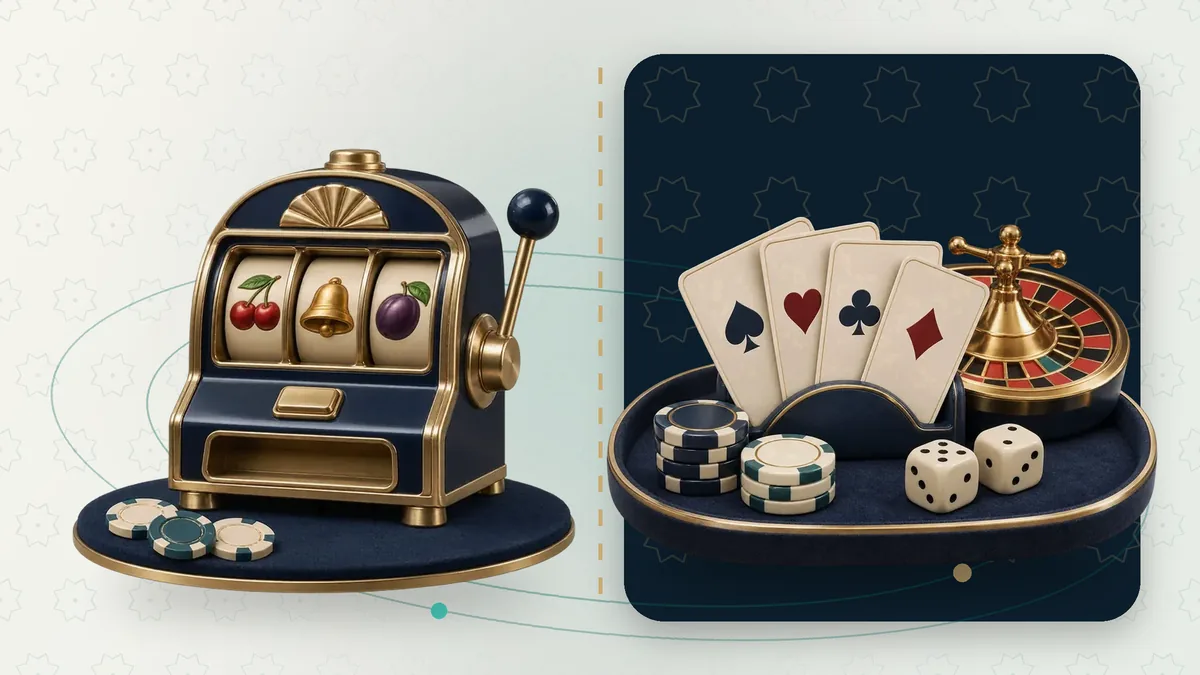
The practice floor is a set of games built into this site, including slots, roulette, blackjack, baccarat, crash, dice and mines, and a betting simulator. The balance is play money, there are no prizes, and no account or deposit is needed.

More importantly, the house edge shown for each game is computed from the site’s own code, not taken from a real casino. The practice slot has an edge of about 2.8%, practice blackjack about 2.1% with the best decisions, and crash 1%. Those are our games’ figures, not those of any title with a similar name at an operator.

What practice can teach you

  • Rules and the flow of a round: when you bet, when it settles, what pays and how much.
  • How multiplier and probability relate: in the dice game you can watch the multiplier fall as the chance of winning rises.
  • Volatility: after twenty spins you can be well up or well down; the trend only shows after hundreds of rounds.
  • What looks like a win but is not: in the practice slot a pair returns half the stake, so you lost the other half.
  • Decimal odds: the betting simulator lets you turn odds into implied probability with no money involved.

What practice cannot tell you

Question Practice play Where the answer is
How the game works Yes, with simplified rules The provider’s game page
A real game’s RTP No What the provider publishes for that title
Wagering and game weighting No The operator’s offer terms
Identity checks and withdrawal limits No The operator’s terms and withdrawal page
UAE licence status No Our legal status page and the review

In my view the third row is the one most often overlooked. The same game can count in full towards wagering at one operator and for less at another, and no practice game will show you that. We work through the arithmetic in what 35x wagering really costs.

A worked example with play money

Hypothetical example 1,000 spins of the practice slot at 10 units a spin is 10,000 units staked. At an edge of about 2.8%, the average theoretical loss is about 280 units. Your actual session could end far above or below that, because the average only appears over a very large number of rounds.

The same arithmetic applies to real play, but with the real game’s numbers: the RTP its provider publishes, and amounts in real currency. Our RTP and volatility guide explains how the two relate.

How to use practice well

  1. Pick a question before you start: a rule you want to understand or a decision you want to test.
  2. Watch the balance over dozens of rounds, not one.
  3. Do not raise the stake after a losing run because a win feels “due”. Every round is independent.
  4. Do not move to real money to win back a play-money balance. That balance never had any value.

Start with the practice slot or practice roulette, and before any real play read our responsible gambling page.

Sources: house-edge figures from the site’s own game code; everything else from our research sheet, 4 November 2026. 21+.

Frequently asked questions

If I win in the practice game, will I win in the real one

No. Every round is independent, and a practice result says nothing about real-money play.

Are the practice games copies of real casino games

No. They are the site’s own games with simplified rules, and each house edge is computed from its code. A real game’s RTP is published by its provider.

Do I need an account or a deposit to practise

No. The balance is play money, there are no prizes and no account is needed.

Written by

Writer

Ahmed Maher is a writer, editor and Arabic translator specialising in online casino and gaming content. He publishes on Casino.org, and his professional profile lists earlier experience at iGaming.com. His work focuses on explaining games and simplifying information about platforms and how to use them.

  • Online casino and gaming content
  • game explainers
  • Arabic translation

Edited and checked by Reine Sevazlian · Last updated: 8 نوفمبر 2026

Reviews written
20
Articles
25

From reading to comparing

Compare the operators in one table

Licence status, identity checks, minimum deposits and withdrawal rules as we found them in the research sheet.

Responsible gambling

Play for entertainment, within limits

Gambling is for adults only (21+) and always carries risk. These habits help keep it within the limits of entertainment.

  • Set a deposit limit

    Decide before you play how much you can spend without it affecting you, per day, week or month.

  • Use reminders

    A reminder every 30 or 60 minutes shows how long you have played and what you have spent.

  • Take a break

    Time-outs and self-exclusion lock your account for days or months, and cannot be undone early.

  • Watch for the signs

    Chasing losses, hiding your play, borrowing to play or feeling anxious when you stop are signs to ask for help.

Need to talk to someone? Talk to a doctor or a counsellor you trust. The responsible gambling page gathers practical steps to set limits or stop.